
Governance, built into the work.
When software acts on your behalf, it should be able to show what it was allowed to do and what it relied on. Rootz puts that evidence inside the message itself — so the system on the other side can check it before it acts, instead of reconstructing it in an audit.
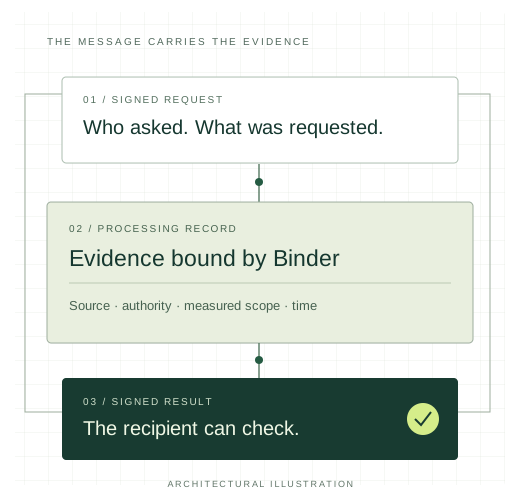
You write the rules. The work carries them.
Almost all governance sits beside the work — a policy document, a control catalogue, a log somebody reads afterwards. It describes what should have happened, and it is read after it already did. That held while a person signed each consequential step. Software takes the step now, thousands of times an hour, with credentials that are entirely valid.
Added-on governance can tell you what happened. It cannot be present when it happens. So Rootz moves it into the work. Every exchange carries who authorized it, what it relied on, and what was measured while it ran. The system receiving it tests that against its own policy and decides — proceed, refuse, or send it for review. On every exchange, not on a sample, and not after an audit surfaces it.
And it travels. Ask most people what governance looks like and they describe a log — a record kept about the work, stored apart from it. But data does not stay where it was made. It is forwarded, cached, quoted, handed to an agent three systems away, and the log stays behind. A log file is governance that stays home. Your data does not. Rootz sends the evidence with it, so it is still checkable by someone with no access to your logs and no reason to take your word for it.
We call this embedded governance: not a record written about the work, but authority and evidence carried inside it.
How Rootz puts governance into the exchangeAn agent that can show its work.
An agent calls a tool, gets an answer, and acts on it. The question nobody can answer afterwards is which answer it used, and whether that answer was any good. Rootz attaches the source evidence, the signed instruction and the measured conditions to the result — so the check is part of the exchange rather than a report written after it.
A licence renewal arrives with proof it was issued under authority. A permit referral carries the plans it was granted against. A tool response carries where its numbers came from. You set the bar each one has to clear; the receiving system enforces it.
Inspect the live evidenceA supply chain for data — in 90 seconds.
The whole idea, on one whiteboard.
One foundation. Different work to do.
One workflow, made checkable end to end.
You pick one exchange that matters — a renewal, a permit referral, an API your customers build on. We agree what has to be true about it, wire the components into the service you already run, and then show you it working: what passes, what fails, and why each one did. You keep an evidence profile describing exactly what the service now proves, and a handover so your team runs it.
See the components and responsibilitiesExtend Zero Trust to the result itself.
Your customer has already bought identity, access control and a hardened perimeter. All of it stops at the edge of the service. The data walks out the door carrying nothing — and it is the data their next system acts on. Rootz sends it out with the answer to three questions attached: who produced this, which request does it answer, and what was measured while it ran.
For an operator that is something new to sell beside the kilowatt — and it asks for almost nothing new to build. A well-run facility already measures its processes, logs its network, knows who is accountable, protects its models and data, and keeps an incident record. You own every one of those instruments. Your customer owns none of the readings. The Binder takes a signed snapshot of what is already there and binds it to the output. What the customer receives is Measured AI: a result that arrives with the conditions it was produced under, checkable by whoever it reaches.
What a data center can offerDon’t take our word for it. Take the block number.
On 15 September 2026 at 15:02 UTC, a public request to Rootz Node returned Polygon block 93,853,009. A check running in the browser verified the signatures, the response-byte commitment and the keyset digest against the published root key. Change one byte of that response and the check fails.
Three services are live and open to anyone. Start with what each one actually proves, then decide how much evidence your own work needs.
We publish the limits as plainly as the claims. Node’s measured evidence covers boot; it does not yet cover the Bor client or runtime integrity. A claim you cannot check is not evidence, and we would rather you found the edge of ours here than in a meeting.
Built into the customer’s infrastructure.
Rootz and Microlink Networks announced a partnership to bring Measured AI to data-center and eGovernment offerings. Microlink builds and runs the infrastructure and knows the customer. Rootz makes what that infrastructure produces checkable. Neither half is the product on its own.
Rootz + Microlink ROOTZ + MICROLINK NETWORKS
Choose the first exchange that needs proof.
An AI tool call. A licence renewal. A permit referral. Start with a service your team already understands.
Plan a working session